WriteHuman, a better alternative to Super Humanizer
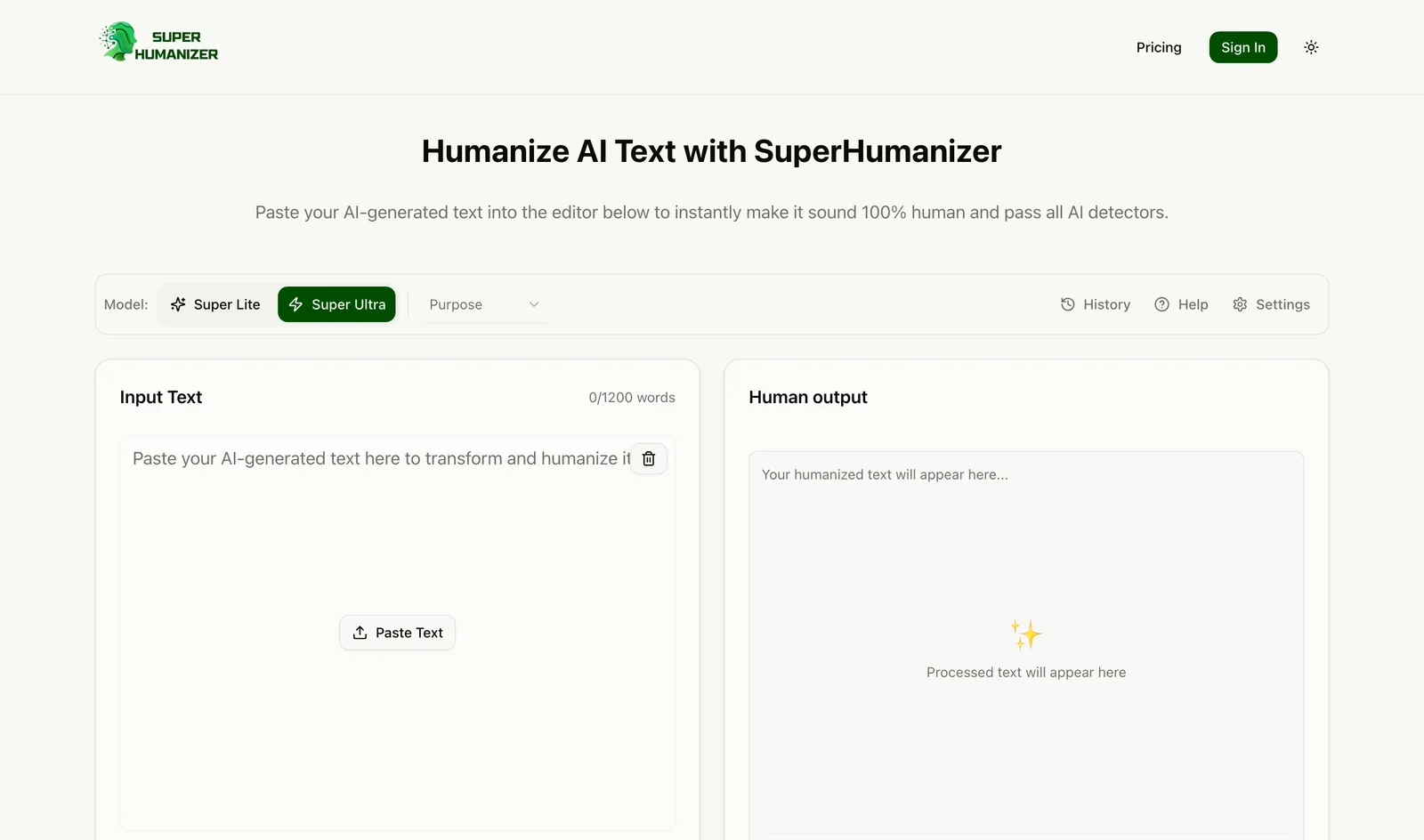
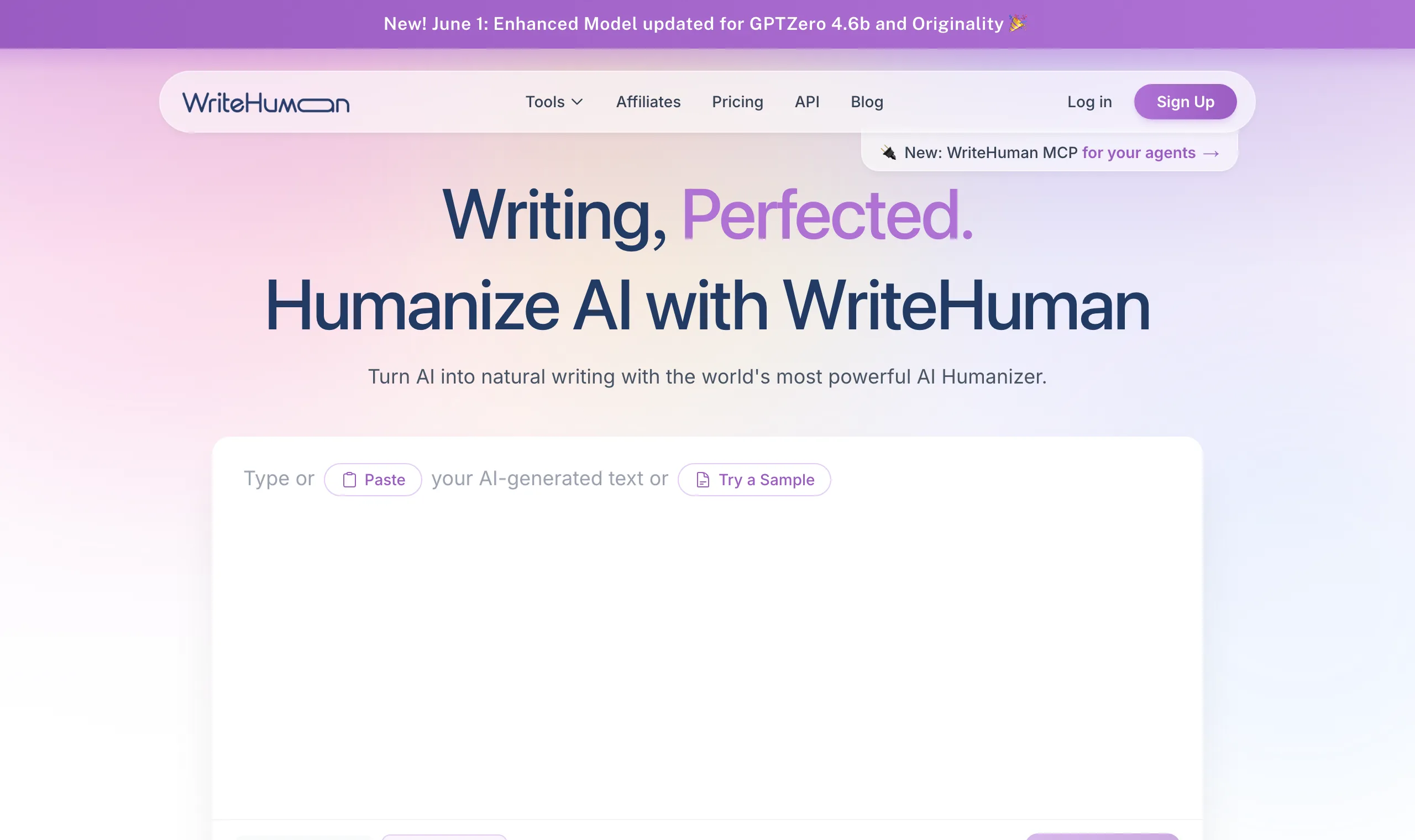
WriteHuman vs Super Humanizer: real-world performance
WriteHuman ranked #1 of 16 humanizers tested in November 2026
HumanizerBench is a public benchmark that re-tests every major AI humanizer each month. Each tool is paid for and run by hand on the same prompts, then scored against 6 major AI detectors on how human the output reads, how well it keeps the original meaning, and how cleanly it's written. Every prompt, output, and detector score is published.
Tested November 202630 samples480 tests6 AI detectors
| Metric | WriteHuman | Super Humanizer |
|---|---|---|
Overall score Composite out of 100. Weights AI-detector results 42%, meaning 32%, readability 16%, and consistency 10%, then subtracts quality penalties. | 70.11 | 59.57 |
AI-detector pass rate Share of checks where the output read as human-written, across all 6 AI detectors. | 81.1% | 41.5% |
Consistency How steady the scores stay across different kinds of writing. | 92.4% | 92.3% |
Quality penalties Points deducted from the overall score for quality issues like length inflation or meaning drift. Lower is worse. | -1 pts | -2 pts |
AI-detector pass rate, by detector Share of checks on each detector where WriteHuman's output read as human-written. Showing detectors where WriteHuman scores higher. | ||
GPTZero | 99.9% | 41.6% |
Winston AI | 97.2% | 63.0% |
ZeroGPT | 87.3% | 60.4% |
Copyleaks | 96.7% | 69.3% |
Score by content type Benchmark score by writing category. Showing categories where WriteHuman scores higher. | ||
Blog posts | 77.5% | 51.4% |
News articles | 67.7% | 35.8% |
Marketing copy | 83.4% | 49.1% |
Discussion posts | 88.6% | 35.7% |
Scoring methodology ↗See the full head-to-head on HumanizerBench ↗
See the actual outputs
The scores above come from real tests, not marketing claims. Here are unedited results from the November 2026 run: the same AI-generated text, humanized by each tool, shown side by side.
**Title: The New Watchdogs: How Independent Journalism is Surviving and Thriving in the Social Media Age** **By Alex Rivera** In an era dominated by algorithmic feeds, viral soundbites, and 280-character hot takes, the media landscape is undergoing its most radical transformation since the invention of the printing press. As traditional legacy outlets shutter bureaus and…
The New Watchdogs: The Rise of Independent Journalism
Alex Rivera
Journalism in the 21st century is almost unrecognizable from the industry of the 20th. Unlike the printing press which modernized, but essentially preserved the structure of the journalism industry, the internet has fundamentally changed it. Mass layoffs and closures by big, established newspapers and news networks allows a surge in independent journalism. This independent journalism uses the very social media which revolutionized and decimated the journalism industry to retain accountability in government and other and authorities.
Complex investigative reporting once relied on the financial backing of large, established news agencies. Now, individual reporters are able to cut ties to large news agencies and financially support themselves through Patreon and other similar sites. Undaunted by corporate advertisement policies and editorials, independent reporters cover mundane but newsworthy and investigative stories.
Dr. Elena Vance elaborates on these topics by stating “Social media broke the traditional business model of news. However, social media was also the means to distribute news stories directly to the audience. Now, we have citizen journalists who directly solicit public funding to support investigations into malfeasance. We have lost the gatekeepers.”
Independent reporters have been first to break news on civil unrest and war. Using cell phone and computer cameras and the internet, these journalists cover un filtered, uncensored news. Instantaneously, these citizen journalists become fact checkers and correct the misrepresentations of the large corporate news networks.
The free-for-all nature of the ecosystem creates numerous risks for independent journalists. Without a traditional news organization’s legal and employment protection, journalists face personal risks, including doxing and lawsuits, which may be initiated to obstruct or punish first amendment-protected activity. Engagement-based algorithms may motivate journalists to cover unsubstantiated stories in an effort to bolster their follower counts and/or shares. Journalists may also become motivated to cover clickbait and sensationalist stories, blurring the line between opinion and news.
Relying on subscriber support for the majority of their income brings unstable and unpredictable wealth for reporters. While a handful of journalists have been able to quit traditional employment after achieving six-figure incomes via subscription services, the majority of reporters covering local beats have been laid off and are forced to work in the “gig economy.” As a result, many reporting deserts have developed.
Audience members’ interest in and preference for independent journalists to report the news has also developed and increased. In the process, many members of the public have lost faith in and trust of the established/legacy news organizations. Indie journalists are quickly moving beyond the status of “alternative” news and are becoming the foundation of a new, decentralized news and information service.
Each tool was run by hand and screen-recorded during the November 2026 run. The outputs are then scored programmatically against 6 major AI detectors, and every input, output, and detector score is published on GitHub. Watch the unedited humanization sessions (video opens in a new tab):
WriteHuman vs Super Humanizer in 60 seconds
The headline differences. Detailed analysis below.
- Free tier
- Free to use, no signup, no card
- Standout
- Ranked #1 of 16 in the November 2026 HumanizerBench cycle with a 70.11 composite, its fifth cycle in a row on top, and scored 99.9% human on GPTZero
- Starting price
- From $12/mo Basic
- Free tier
- Free: up to 1,200 words per run
- Watch for
- A free, deep-rewrite humanizer marketed for quick rewrites
Bottom line: Super Humanizer is free and quick, but a 41.6% GPTZero score and a 41.5% AI-detector pass rate make WriteHuman the safer pick when the writing has to score as human-written.
Benchmark performance
#1 versus #11, with fewer quality penalties
In the November 2026 HumanizerBench cycle, a public monthly benchmark, WriteHuman scored a composite of 70.11 and finished first of the 16 humanizers tested, its fifth cycle in a row at #1. Super Humanizer scored 59.57 and finished eleventh, 10.54 points behind. WriteHuman was also docked fewer quality-penalty points: one, to Super Humanizer's two.
Each output is checked by six AI detectors (GPTZero, Winston AI, ZeroGPT, Copyleaks, Originality.ai, and Pangram) and its score is the average of all six verdicts, so a tool has to get past every detector to post a high pass rate. WriteHuman, tested on its entry-level Basic plan, came out ahead of Super Humanizer on all six.
Super Humanizer
Super Humanizer's composite in the November 2026 cycle, eleventh of 16.
WriteHuman
WriteHuman's composite, first of 16 for the fifth cycle in a row.
Per-detector results
WriteHuman beats Super Humanizer on all six detectors, GPTZero included
GPTZero is one of the first detectors most writers check, and the two tools split far apart there. In the November 2026 cycle WriteHuman scored as human-written on GPTZero 99.9% of the time, while Super Humanizer scored 41.6%. WriteHuman also posted 97.2% on Winston AI against Super Humanizer's 63.0%. ZeroGPT and Copyleaks went the same way, at 87.3% versus 60.4% and 96.7% versus 69.3%.
WriteHuman's built-in detector is tuned to closely match GPTZero, Originality.ai, Copyleaks, ZeroGPT, and Winston AI, so the score you see in the app is close to what those tools will report. With Super Humanizer you finish the rewrite, switch to a separate detector, and often find the result still flags as AI.
Super Humanizer
Super Humanizer's GPTZero score in the November 2026 cycle.
WriteHuman
WriteHuman's GPTZero score in the same cycle.
Content types
Super Humanizer slips on discussion posts and marketing copy
The benchmark breaks results down by content type, and WriteHuman led Super Humanizer on blog posts, news articles, marketing copy, and discussion posts. The widest of those gaps were discussion posts, where WriteHuman scored 88.6% to Super Humanizer's 35.7%, and marketing copy, at 83.4% versus 49.1%. Blog posts ran 77.5% for WriteHuman versus 51.4%, and WriteHuman led on news articles too.
That is the practical story. Super Humanizer might land one rewrite, then fall short on the next marketing brief or forum reply. WriteHuman keeps its lead across formats, so you are not re-running and re-checking every time the content changes.
Super Humanizer
Super Humanizer's discussion-post score in the November 2026 cycle.
WriteHuman
WriteHuman's discussion-post score in the same cycle.
AI-detector pass rate
Results that hold up across all six detectors
A single good rewrite is not the same as a tool you can rely on. HumanizerBench averages every output's verdicts across all six detectors, so one friendly checker cannot carry a tool. In the November 2026 cycle WriteHuman posted an 81.1% AI-detector pass rate on its entry-level Basic plan, against Super Humanizer's 41.5%.
Pair that with the per-detector results and the picture is clear: WriteHuman held 99.9% on GPTZero and 96.7% on Copyleaks. A tool that lands one rewrite and misses the next costs you the time you thought you were saving, so WriteHuman puts the built-in detector in the same view and shows you the real score before you commit.
Super Humanizer
Super Humanizer's AI-detector pass rate in the November 2026 cycle, averaged across six detectors.
WriteHuman
WriteHuman's pass rate across the same six detectors, on its Basic plan.
Pricing: WriteHuman vs Super Humanizer
Side-by-side plans. WriteHuman's free tier is on the homepage. No signup needed.
Free
$0
Try the humanizer with daily limits, no signup
- No credit card
- Daily request cap
- Built-in AI detector access
Basic
$20/mo
80 humanizations / month, up to 600 words each
- 2 output variations
- 160 AI detector checks / mo
- Cancel anytime
Pro
$29/mo
200 humanizations / month, up to 1,200 words each
- 3 output variations
- 400 AI detector checks / mo
- Priority support
Ultra
$59/mo
Unlimited humanizations, up to 3,000 words each
- 5 output variations
- Unlimited AI detector checks
- Priority support
Free
$0
Up to 1,200 words per run, unlimited usage
Basic
$12/mo
15,000 words/mo, 1,500 words per input
Pro
$19/mo
50,000 words/mo, 3,000 words per input
Advanced
$39/mo
200,000 words/mo, 5,000 words per input
Pricing verified as of . For the latest Super Humanizer pricing, see superhumanizer.ai.
Feature Comparison
See how WriteHuman stacks up against Super Humanizer, feature by feature.
Why writers pick WriteHuman
The everyday reasons writers switch to WriteHuman from Super Humanizer.
Pick WriteHuman if…
- You need writing that scores as human-written on GPTZero, where WriteHuman scored 99.9% to Super Humanizer's 41.6%.
- You rewrite discussion posts or marketing copy, two content types where Super Humanizer trailed WriteHuman by wide margins.
- You want a lead that holds whether the piece is a blog post, a news article, or a discussion reply.
- You want a built-in AI detector tuned to match GPTZero, Winston AI, Copyleaks, ZeroGPT, and Originality.ai before you publish.
- You want a humanizer that beat Super Humanizer on all six AI detectors in the November 2026 benchmark.
Pick Super Humanizer if…
- You only need an occasional free, no-signup rewrite and nothing downstream is checking for AI.
- You want a quick, free deep-rewrite and are comfortable verifying the result yourself on a separate detector.
Why users switch from Super Humanizer
Real pain points Super Humanizer users run into, and how WriteHuman solves each one.
Super Humanizer
Posted a 41.5% AI-detector pass rate in the November 2026 benchmark, versus WriteHuman's 81.1%.
WriteHuman
WriteHuman posted an 81.1% AI-detector pass rate on its entry-level Basic plan in the same November 2026 cycle, scored against the average of all six detectors.
Super Humanizer
Scored 41.6% on GPTZero and 63.0% on Winston AI, and trailed WriteHuman on all six detectors.
WriteHuman
WriteHuman scored 99.9% on GPTZero, 97.2% on Winston AI, and 96.7% on Copyleaks, ahead of Super Humanizer on each.
Super Humanizer
Scored 35.7% on discussion posts and 49.1% on marketing copy, versus WriteHuman's 88.6% and 83.4%.
WriteHuman
WriteHuman led Super Humanizer on discussion posts (88.6%), marketing copy (83.4%), blog posts (77.5%), and news articles.
Super Humanizer
Was docked two points in quality penalties, against one for WriteHuman.
WriteHuman
WriteHuman took fewer quality penalties than Super Humanizer and kept its lead on every content type compared, whether you are rewriting a blog post or a marketing brief.
Super Humanizer
Finished 11th of the 16 humanizers in the November 2026 cycle, with a 59.57 composite to WriteHuman's 70.11.
WriteHuman
WriteHuman finished first of the 16 humanizers tested for the fifth cycle in a row, and shows the real detector score in the same view before you ship.
Frequently asked: WriteHuman vs Super Humanizer
Is there a better Super Humanizer alternative for content that has to score as human-written?
How does Super Humanizer compare to WriteHuman on AI detectors?
Where does Super Humanizer trail WriteHuman?
Is Super Humanizer free, and is WriteHuman free too?
Why pick WriteHuman over Super Humanizer?
Ready to make the switch?
Join 10,000,000+ writers who trust WriteHuman to transform their AI content into polished, natural-sounding writing.
No credit card required
